Home › Question bank › Area & Perimeter
P6 Area & Perimeter Questions (with Worked Solutions)
Area and perimeter of composite figures, triangles, and circles in P6 prelim papers. Every question is from a real Singapore P6 preliminary exam, marked instantly, with step-by-step solutions.
Try the free sample → Browse S$5 papers Browse all questions46
Area & Perimeter questions
10
Top-school papers
Instant
Auto-marking
Example Area & Perimeter questions
A few real area & perimeter questions from P6 prelim papers. The full set — with marking and progress tracking — is inside SG Maths Exam.
(a)
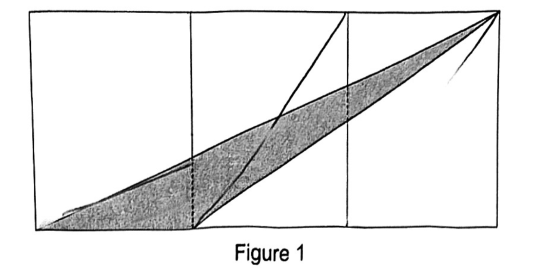
Figure 1 shows three identical rectangles. The area of the shaded triangle is 256 cm^2. Find the difference in area between the shaded and unshaded parts.
Worked solution — (a)
- Shaded triangle = $\frac{1}{6}$ of three rectangles. Unshaded = $\frac{5}{6}$. Difference = $\frac{5}{6} - \frac{1}{6} = \frac{4}{6}$ of three rectangles. Three rectangles = $6 \times 256 = 1536$. Difference = $\frac{4}{6} \times 1536 = 1024$ cm^2.
(b)
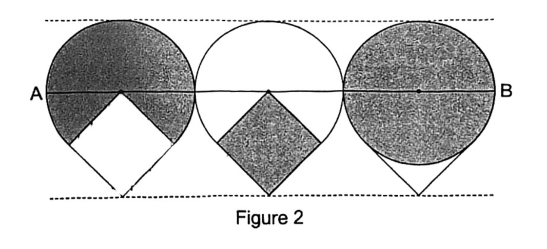
Figure 2 is formed by three similar-sized circles and three similar-sized squares. Line $AB$ passes through the centre of the three circles. The area of each square is 256 cm^2. Find the difference in area between the shaded and unshaded parts. (Take $\pi = 3.14$)
Worked solution — (b)
- $\sqrt{256} = 16$. Shaded = 7 quarters + 1 square
- Unshaded = 3 quarters + 1 square + 1 boomerang (1 square - 1 quarter). Difference = 4 quarters - 1 boomerang. 4 quarters = 1 circle = $3.14 \times 16 \times 16 = 803.84$. 1 boomerang = $256 - \frac{1}{4} \times 3.14 \times 16 \times 16 = 256 - 200.96 = 55.04$. Difference = $803.84 - 55.04 = 748.8$ cm^2.
(a)
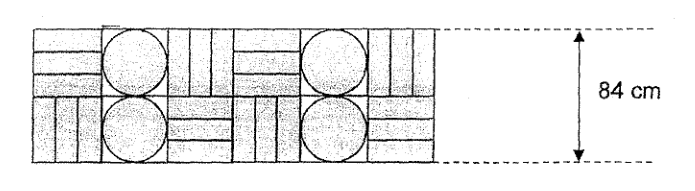
A footpath of length 25.2 m is tiled using identical rectangular tiles and identical circular tiles, following the pattern shown. Each tile is in contact with those next to it. The width of the footpath is 84 cm. (Take $\pi = \frac{22}{7}$) (a) How many rectangular and circular tiles were used to tile the entire footpath altogether?
Worked solution — (a)
- Footpath length $= 25.2\text{ m} = 2520\text{ cm}$. Each circular tile has diameter $84 \div 2 = 42\text{ cm}$, and one pattern block is $3 \times 42 = 126\text{ cm}$ long. Number of blocks $= 2520 \div 126 = 20$. Each block has $6 + 1 = 7$ tiles, so total $= 20 \times 7 = 140$ tiles per row, and with 2 rows, $140 \times 2 = 280$ tiles.
(b)
For the tiled footpath, (b) Find the area of the footpath not covered by tiles.
Worked solution — (b)
- There are $20 \times 2 = 40$ circular tiles. Each circular tile sits in a $42\text{ cm}$ square of area $42 \times 42 = 1764\text{ cm}^2$, while the circle has area $\frac{22}{7} \times 21 \times 21 = 1386\text{ cm}^2$. Uncovered area per circle $= 1764 - 1386 = 378\text{ cm}^2$. Total uncovered area $= 378 \times 40 = 15120\text{ cm}^2$.
(c)
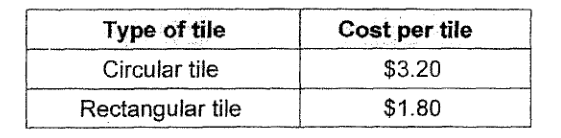
For the tiled footpath, (c) All the tiles on the footpath need to be replaced. A circular tile costs \$3.20 and a rectangular tile costs \$1.80. What is the total cost to replace all the tiles on the footpath?
Worked solution — (c)
- Circular tiles $= 40$, rectangular tiles $= 280 - 40 = 240$. Cost $= 240 \times \$1.80 + 40 \times \$3.20 = \$432 + \$128 = \$560$.
(a)
The figure is made up of 3 identical big circles, 2 identical small circles and 2 identical squares. The area of each square is 200 cm^2. Find the radius of the big circle.
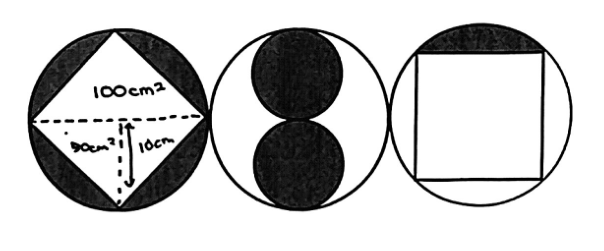
Worked solution — (a)
- Each square has area $200\text{ cm}^2$ and is inscribed in a big circle so that its diagonal is the diameter. The diagonal squared $= 2 \times 200 = 400$, so the diameter $= 20$ cm. The radius of the big circle $= 20 \div 2 = 10$ cm.
(b)
Find the total area of the shaded parts. (Take $\pi = 3.14$.)
Worked solution — (b)
- Using the big circle radius $10$ cm, the small circles and squares, the shaded regions are found by subtracting the unshaded areas from the circle areas. Combining all shaded parts gives a total shaded area of $299.5\text{ cm}^2$.
The shaded figure is made up of a large semicircle and a square with a small semicircle cut-out from the square. The diameter of the small semicircle is 10 cm, and the diameter of the large semicircle is twice the length of the diameter of the small semicircle. What is the perimeter of the shaded figure? (Take $\pi = 3.14$)
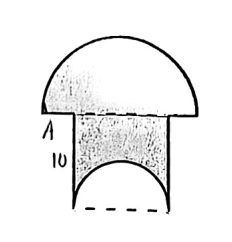
- 1. 77.1 cm
- 2. 71.4 cm
- 3. 67.1 cm
- 4. 61.4 cm
Worked solution
- \(\text{Small semicircle: } d = 10,\ r = 5,\ \text{arc} = \pi \times 5 = 15.7 \text{ cm}\)
- \(\text{Large semicircle: } d = 20,\ r = 10,\ \text{arc} = \pi \times 10 = 31.4 \text{ cm}\)
- \(\text{Add the relevant straight edges from the figure}\)
- \(\text{Perimeter} = 77.1 \text{ cm}\)
The figure is made up of one big semicircle and a small semicircle. The large semicircle with centre O has a radius of 6 cm. Find the perimeter of the figure. Leave your answer in terms of $\pi$.
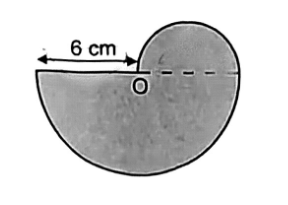
- 1. \(6\pi \text{ cm}\)
- 2. \(9\pi \text{ cm}\)
- 3. \((6\pi + 6) \text{ cm}\)
- 4. \((9\pi + 6) \text{ cm}\)
Worked solution
- \(\text{Big semicircle arc} = \pi \times 6 = 6\pi \text{ cm}\)
- \(\text{Small semicircle radius} = 12 \div 2 \div 2 = 3 \text{ cm}\)
- \(\text{Small semicircle arc} = \pi \times 3 = 3\pi \text{ cm}\)
- \(\text{Exposed straight edge} = 6 \text{ cm}\)
- \(\text{Perimeter} = 6\pi + 3\pi + 6 = (9\pi + 6) \text{ cm}\)
The figure is made up of two identical semicircles with radius of 21 m. Find the perimeter of the figure in terms of $\pi$.
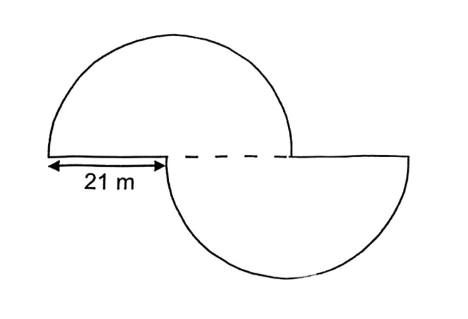
- 1. 21$\pi$ m
- 2. (21$\pi$ + 21) m
- 3. 42$\pi$ m
- 4. (42$\pi$ + 42) m
Worked solution
- \(\text{Each semicircle arc} = \pi \times 21 = 21\pi \text{ m}\)
- \(\text{Total arc length} = 2 \times 21\pi = 42\pi \text{ m}\)
- \(\text{Straight edge (diameter)} = 2 \times 21 = 42 \text{ m}\)
- \(\text{Perimeter} = (42\pi + 42) \text{ m}\)
Practise Area & Perimeter the smart way
Drill only the questions your child needs, marked on the spot, with worked solutions. Try a free sample first — no signup needed, then pick a full paper for S$5 when you are ready. One-time payment, no subscription.
Other P6 maths topics
Or browse by school on the P6 prelim papers index.