Home › Question bank › Volume
P6 Volume Questions (with Worked Solutions)
Volume of cubes, cuboids, and liquids — P6 prelim practice. Every question is from a real Singapore P6 preliminary exam, marked instantly, with step-by-step solutions.
Try the free sample → Browse S$5 papers Browse all questions48
Volume questions
10
Top-school papers
Instant
Auto-marking
Example Volume questions
A few real volume questions from P6 prelim papers. The full set — with marking and progress tracking — is inside SG Maths Exam.
(a)
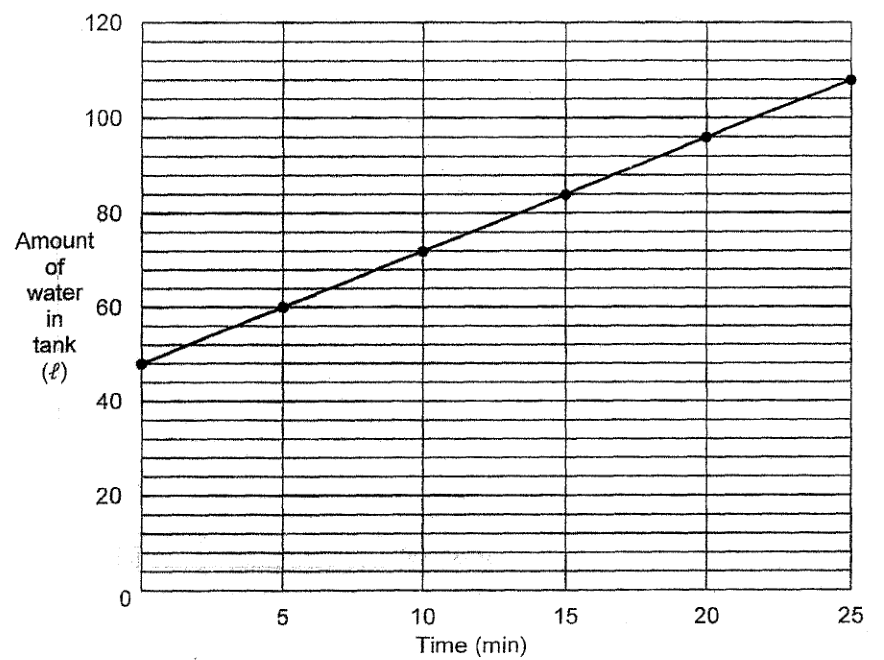
At first, $\frac{3}{8}$ of a fish tank was filled with water. A tap was turned on for more water to flow into the tank. It was then turned off after 25 minutes. The line graph shows the amount of water in the tank over the 25 minutes. (a) How many litres of water flowed into the tank in one minute?
Worked solution — (a)
- From the graph the water rose from 48 l to 60 l over the first 5 minutes: $\frac{60 - 48}{5} = \frac{12}{5} = 2.4\text{ l per minute}$.
(b)
For the fish tank, (b) At the end of 25 minutes, what fraction of the tank was not filled with water?
Worked solution — (b)
- $\frac{3}{8}$ of the tank $= 48\text{ l}$, so $\frac{1}{8} = 16\text{ l}$ and the full tank $= 8 \times 16 = 128\text{ l}$. After 25 minutes the tank held 108 l, so $128 - 108 = 20\text{ l}$ was empty. Fraction not filled $= \frac{20}{128} = \frac{5}{32}$.
(c)
For the fish tank, (c) The tap was turned on again at the same rate as before. How many more minutes did it take to fill the tank completely?
Worked solution — (c)
- Water still needed $= 20\text{ l}$. At $2.4\text{ l per minute}$, time $= 20 \div 2.4 = 8\frac{1}{3}\text{ min}$.
(a)
Tank G and Tank H are rectangular containers. Tank H measures 40 cm long, 30 cm wide and 15 cm high. Tank H is $\frac{5}{8}$ full of water. What is the volume of water in Tank H?
Worked solution — (a)
- Capacity of Tank H $= 40 \times 30 \times 15 = 18\,000\text{ cm}^3$. Volume of water $= \frac{5}{8} \times 18\,000 = 11\,250\text{ cm}^3$.
(b)
Tank G is $\frac{3}{5}$ full of water. After all the water from Tank H is poured into Tank G, Tank G is then $\frac{7}{10}$ full of water. The base area of Tank G is 5000 cm^2. Find the height of Tank G.
Worked solution — (b)
- The water poured in from Tank H is $11\,250\text{ cm}^3$, which raised Tank G from $\frac{3}{5}$ to $\frac{7}{10}$ full. The increase $= \frac{7}{10} - \frac{3}{5} = \frac{7}{10} - \frac{6}{10} = \frac{1}{10}$ of Tank G. So $\frac{1}{10}$ of the capacity $= 11\,250\text{ cm}^3$, capacity $= 112\,500\text{ cm}^3$. Height $= 112\,500 \div 5000 = 22.5$ cm.
(a)
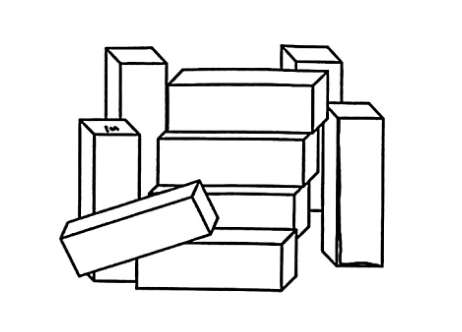
Lilian had nine identical wooden cuboids. The volume of each cuboid is 648 cm^3. She glued these nine cuboids to form a cube. Find the length of the cube.
Worked solution — (a)
- Total volume of the cube $= 9 \times 648 = 5832\text{ cm}^3$. The length of the cube $= \sqrt[3]{5832} = 18$ cm.
(b)
Lilian dipped the cube into a pail of paint. She then separated the cube back into the nine original wooden cuboids. Find the total unpainted area of the nine wooden cuboids.
Worked solution — (b)
- Total surface area of all 9 cuboids: each cuboid is $18 \times 18 \times 2 = 648$, so each cuboid measures $18\text{ cm} \times 18\text{ cm} \times 2\text{ cm}$. Surface area of one cuboid $= 2(18 \times 18 + 18 \times 2 + 18 \times 2) = 2(324 + 36 + 36) = 792\text{ cm}^2$. Total for 9 cuboids $= 9 \times 792 = 7128\text{ cm}^2$. The painted area is the cube's outer surface $= 6 \times 18 \times 18 = 1944\text{ cm}^2$. But internal painted surfaces appear when separated
- total painted $= 7128 - 2592$. Unpainted area $= 2592\text{ cm}^2$.
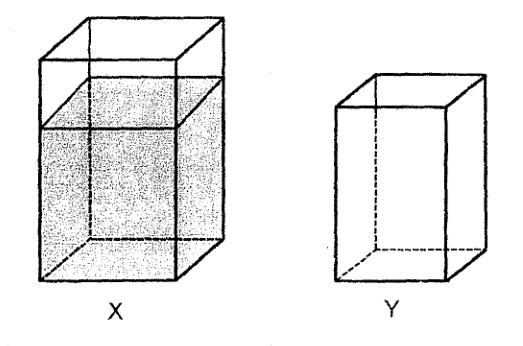
X and Y are two rectangular tanks. At first, X was filled with some water and Y was empty. The base area of Y is 135 cm^2. Some water was poured from X to Y without spilling. In the end, the amount of water in Y was 2430 cm^3. The height of water in X was $\frac{3}{4}$ the height of water in Y. The amount of water then left in X was $\frac{2}{3}$ the amount of water in Y. What is the base area of X?
Worked solution
- Height of water in Y $= 2430 \div 135 = 18\text{ cm}$. Height of water in X $= \frac{3}{4} \times 18 = 13.5\text{ cm}$. Volume of water in X $= \frac{2}{3} \times 2430 = 1620\text{ cm}^3$. Base area of X $= 1620 \div 13.5 = 120\text{ cm}^2$.
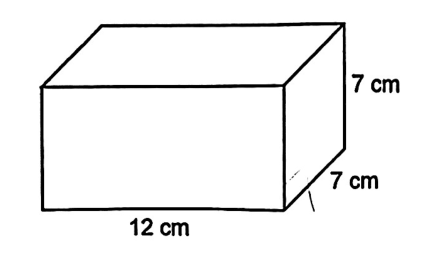
A cuboid measuring 12 cm by 7 cm by 7 cm was dipped into some red paint. The cuboid was then cut into 1-cm cubes. How many of the cubes would have none of their surfaces painted red?
- 1. 588
- 2. 539
- 3. 396
- 4. 250
Worked solution
- \(\text{Unpainted cubes form the inner block, one layer in from every face}\)
- \((12 - 2) \times (7 - 2) \times (7 - 2) = 10 \times 5 \times 5 = 250\)
Amelia used identical unit cubes to build a solid. She drew the top and side views of the solid as shown below.
Which of the following could be the solid built by Amelia?
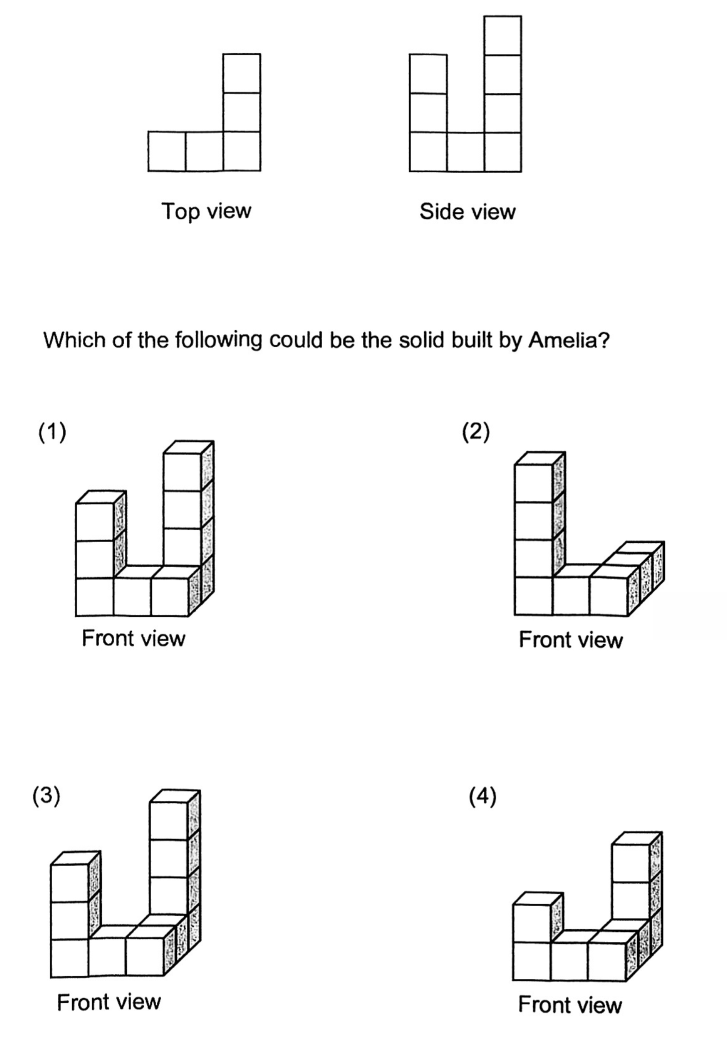
- 1. Diagram of a solid
- 2. Diagram of a solid
- 3. Diagram of a solid
- 4. Diagram of a solid
Worked solution
- \(\text{Match the given top view and side view to each option}\)
- \(\text{Only option (3) produces both views consistently}\)
Practise Volume the smart way
Drill only the questions your child needs, marked on the spot, with worked solutions. Try a free sample first — no signup needed, then pick a full paper for S$5 when you are ready. One-time payment, no subscription.
Other P6 maths topics
Fractions & DecimalsAngles & GeometryWhole NumbersArea & PerimeterPercentageAlgebraRatioData AnalysisMoney
Or browse by school on the P6 prelim papers index.